
Technology
The Technology Behind Iron Gate Security
Iron Gate Technologies designs, engineers, and builds AI-powered security systems in-house in Holly Hill, Florida. Our cameras detect firearms in under 3 seconds, run on solar power with cellular connectivity, and give you the option to keep all footage on your own infrastructure.
AI Detection: How It Works
Our cameras watch for threats the way a trained operator would, and they do it in real time, around the clock, without needing a person staring at a screen.
Iron Gate uses computer vision to identify threats as they happen. The system detects firearms in under 3 seconds and sends automated alerts to your security team and, where appropriate, to law enforcement, without depending on a human to catch the threat on a feed. Alongside gun detection, the AI handles person and vehicle detection, face recognition, license plate reading, and behavior analysis.
AI threat detection is now common across the security market. Most serious vendors have some version of it. That is exactly why the question worth asking is not whether a system has AI, but how fast it reacts and where the data it generates ends up. Iron Gate answers both directly: detection in under 3 seconds, and footage that can stay entirely on infrastructure you control.
All Iron Gate AI detection is developed in compliance with ISO/IEC 42001, the international standard for AI management systems. That standard governs how the AI is built, tested, and managed over its lifecycle, which matters for any buyer who has to answer for an automated system during an audit or a funding review.
The detection models run on the system itself, so a unit keeps watching and classifying even when its link to a monitoring center is degraded or down. Nothing about threat detection waits on a round trip to a distant server.
Camera and Hardware Platform
The hardware is built to take a beating outdoors for years, because security gear that fails in weather is not security gear.
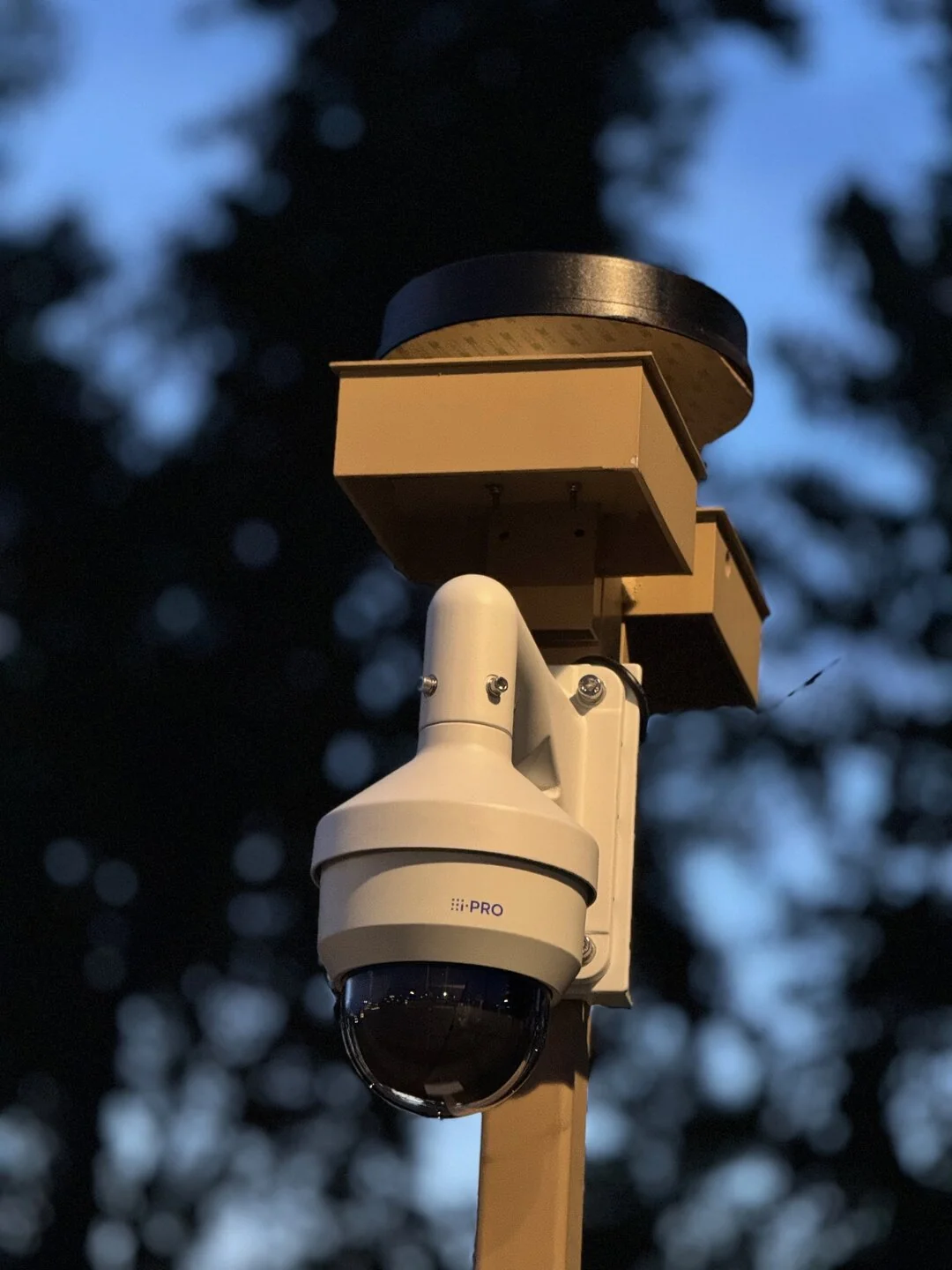
Iron Gate cameras deliver up to 4K Ultra HD resolution with infrared and thermal night-vision options, so the system keeps producing usable footage in full darkness, not just a black frame with a timestamp. The flagship 4K camera (model 3090) and the 1080p camera (model 2030) are built for continuous outdoor duty.
The cameras carry an IP66 rating against dust and water and an IK10 rating against physical impact and vandalism. IP66 means the housing is sealed against heavy rain and wind-driven water. IK10 is the highest impact rating in its scale, the level built to withstand a deliberate strike. For the portable SecMods platform, the enclosure that houses the system is rated IP67, a step beyond the camera rating because the trailer-mounted unit faces standing water and full immersion conditions a fixed camera does not.
Mounting goes up to a 22-foot mast on portable units, and the systems operate across a wide temperature band, from well below freezing to desert heat. Every unit is built to stay operational through hurricanes, heat, and humidity, which is the baseline for hardware engineered and tested in Florida.
This is physical engineering, not a spec sheet borrowed from a supplier. The hardware platform is chosen and assembled in-house, which is what lets Iron Gate stand behind the weather and impact ratings rather than passing through a vendor's claims.
Data Architecture: On-Premise, Cloud, or Hybrid
You decide where your footage lives. With Iron Gate, that can mean it never leaves your building.
Security camera data can be stored three ways, and the difference matters more than most buyers realize. Cloud storage keeps footage on a vendor's remote servers. Hybrid keeps some data local and sends the rest to the cloud. On-premise keeps everything on hardware the customer owns and controls, on site.
Iron Gate supports the model you need, including true on-premise, where surveillance footage stays on your own servers and no outside provider ever touches it. For government, healthcare, and other regulated buyers, this is the architecture that supports data-sovereignty mandates: footage stays on customer-controlled infrastructure, which aligns with NIST SP 800-53 physical and environmental controls and FISMA requirements for federal information systems.
Here is the part the market does not advertise. Cloud-only systems cannot offer true on-premise storage, because the cloud is the product. Their architecture sends your footage off site by design, and the hardware often stops working if the subscription lapses. If your security policy requires an air gap, prohibits third-party cloud custody of recordings, or simply demands that you own your data outright, a cloud-only system cannot meet that requirement no matter how the contract is written.
Iron Gate's position is straightforward: you own the hardware, and you choose where the data lives. That choice is not a premium add-on or a future roadmap item. It is the architecture.
Tell us your data-handling requirements and we will design an architecture that meets them.
Certifications and Compliance
The certifications below are the ones a procurement officer or compliance lead actually checks. Here they are, stated plainly.
Encryption and secure hardware
Hardware secure element; current validation details per model on request.
Physical and impact protection
Cameras are rated IP66 for dust and water ingress and IK10 for impact and vandal resistance. SecMods enclosures are rated IP67.
NDAA Section 889 compliance
NDAA Section 889 compliance attaches to the specific model, not the brand on the housing, so the right question for any vendor is which models are covered. Iron Gate provides current compliance documentation for the specific models in your procurement, on request. Call 904-896-5618.
AI governance
All AI detection is developed in compliance with ISO/IEC 42001, the international standard for AI management systems.
Federal procurement
Iron Gate is positioned for GSA Schedule inclusion, giving federal procurement officers a direct acquisition path, and provides Buy American Act documentation for specific models on request.
For a federal, institutional, or grant-funded buyer, this section is the audit. Every item here is a real standard a reviewer can verify, stated without marketing softening.
Self-Contained Operation: Power and Connectivity
Iron Gate's portable systems run anywhere, with no power cord and no network drop, by default.
A SecMods unit runs 24/7 on solar power with a 72-hour battery backup and connects through 4G and 5G LTE cellular. No external power. No WiFi. No trenching, no electricians, no permits. A unit arrives pre-configured and tested, and deploys in under 30 minutes: position it, power it on, and it is watching.
This is an architecture difference, not a single product feature. A cloud camera still needs a power source and a network connection to do its job, which means a buyer has to solve power and connectivity before the camera is worth anything. Iron Gate's portable platform solves both inside the unit. That is what makes it practical to secure a construction site, a remote substation, a fence line, or an event venue where running infrastructure would be slow, expensive, or impossible.
Because power and connectivity are self-contained, the surveillance also stays up during the exact moments a site is most exposed: a network outage, planned IT maintenance, or a security event on the facility's own systems.
American In-House Manufacturing
Iron Gate is a manufacturer, not a reseller. The systems are designed, engineered, and assembled by our own team in Florida.
Every Iron Gate system is built in-house at the company's manufacturing facility in Holly Hill, Florida. Designed here, engineered here, assembled here. That is not a marketing line, it is the operating model, and it is what makes the rest of this page possible.
In-house manufacturing means Iron Gate controls quality, customization, and delivery timelines directly rather than waiting on an overseas supplier. It is the reason the company can engineer a custom solution for a specific facility layout or threat profile instead of handing a customer a fixed commercial platform and a configuration menu. The engineering is genuine: Iron Gate holds 11 patents in security technology, which is proprietary innovation.
Production is veteran-led, and the same team that builds the hardware stands behind it through Iron Gate's warranty and overnight RMA support. When you buy from Iron Gate, you are buying from the people who designed and assembled the unit in Holly Hill, FL, not a distributor reselling someone else's box.
Talk to the team that engineers and builds the hardware.
See the Technology in Your Environment
Every Iron Gate system is engineered, built, and supported by one American team. If you are evaluating whether this is real engineering or a repackaged commodity box, the fastest way to find out is to put your requirements in front of the people who build it.
Book a Security AssessmentStill researching? Read the Security Camera Buyer's Guide or browse the FAQ.